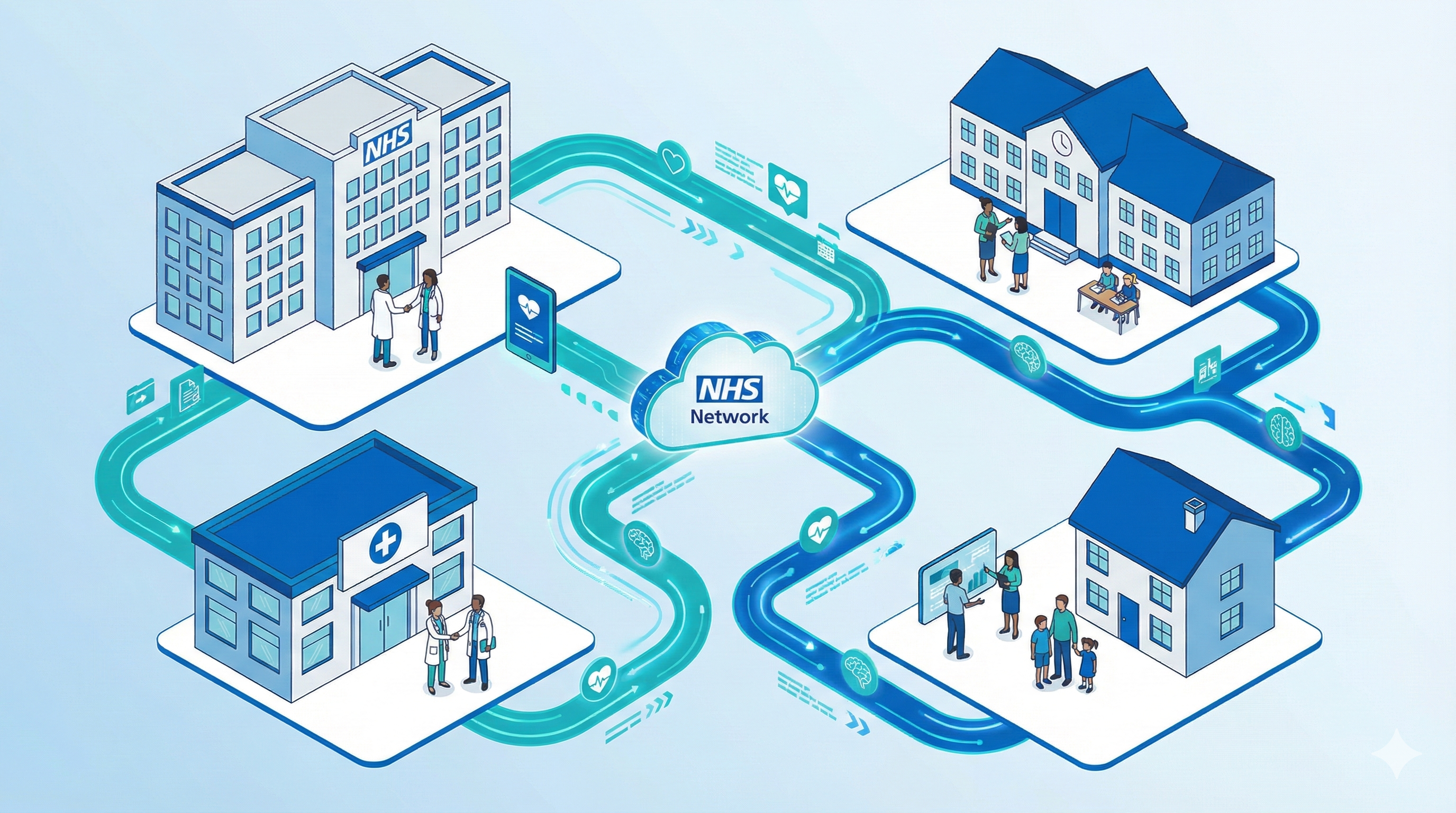
Integrating new digital tools into established NHS care pathways requires careful planning and stakeholder engagement. This article shares implementation guidance and lessons learned from NHS organisations that have successfully embedded digital health passports into their clinical workflows.
The Integration Challenge
Healthcare organisations face common challenges when introducing digital health tools:
- Workflow disruption - New tools must fit into existing clinical processes
- System interoperability - Data needs to flow between multiple systems
- Staff adoption - Clinicians need training and support
- Governance requirements - Information governance and clinical safety must be assured
- Resource constraints - Implementation competes with other priorities
TMA has worked with 28 NHS trusts to address these challenges, developing proven approaches that minimise disruption while maximising benefit.
Integration Models
Different organisations have adopted different integration approaches depending on their technical infrastructure and clinical workflows.
Model 1: Standalone Digital Passport
Description: Passports operate independently from the clinical EPR, with clinicians accessing them via a separate web application.
Best for: Organisations with limited technical integration capacity or those wanting to pilot before deeper integration.
Advantages:
- Rapid implementation (typically 4-6 weeks)
- Minimal IT resource required
- Low risk to existing systems
Considerations:
- Requires double data entry in some scenarios
- Less seamless clinician experience
Model 2: EPR-Linked Passport
Description: Passports are accessible via links embedded in the clinical EPR, with contextual patient lookup.
Best for: Organisations with mature EPR systems and available integration capacity.
Advantages:
- Single sign-on for clinicians
- Patient context automatically passed
- More seamless workflow
Considerations:
- Requires IT development time
- Needs EPR vendor cooperation
Model 3: Fully Integrated Passport
Description: Passport data flows bidirectionally between TMA and the clinical EPR, with automatic updates in both directions.
Best for: Organisations seeking comprehensive digital transformation.
Advantages:
- Eliminates duplicate data entry
- Real-time synchronisation
- Comprehensive audit trail
Considerations:
- Most complex implementation
- Requires HL7 FHIR capability
- Longest implementation timeline
Implementation Roadmap
Based on successful implementations across multiple NHS organisations, we recommend a phased approach:
Phase 1: Foundation (Weeks 1-4)
Governance Setup
- Establish project governance structure
- Complete Data Protection Impact Assessment (DPIA)
- Obtain Caldicott Guardian approval
- Sign Data Processing Agreement with TMA
Stakeholder Engagement
- Identify clinical champions in each specialty
- Engage patient representatives
- Brief relevant committees (CCIO, nursing, AHPs)
- Establish communication plan
Technical Preparation
- Define integration requirements
- Confirm network access requirements
- Plan single sign-on (if applicable)
- Set up test environment
Phase 2: Configuration (Weeks 5-8)
Clinical Content Setup
- Select conditions for initial rollout
- Customise passport templates to local pathways
- Configure escalation contacts
- Set up emergency protocols
User Access
- Create staff accounts and roles
- Configure access permissions
- Set up audit logging
- Test access from clinical areas
Family Onboarding
- Prepare patient information materials
- Create onboarding workflows
- Train reception/admin staff on registration process
- Set up support pathways for families
Phase 3: Pilot (Weeks 9-12)
Limited Rollout
- Begin with single condition/clinic
- Closely monitor adoption and issues
- Gather feedback from clinicians and families
- Iterate based on learning
Training Delivery
- Deliver clinician training sessions
- Provide admin staff training
- Create quick reference guides
- Establish super-user network
Evaluation
- Track key metrics (adoption, usage, satisfaction)
- Document lessons learned
- Identify process improvements
- Plan for broader rollout
Phase 4: Scale (Weeks 13+)
Expanded Rollout
- Extend to additional conditions
- Increase clinic coverage
- Onboard additional staff groups
- Scale family recruitment
Optimisation
- Refine workflows based on experience
- Address integration gaps
- Improve training materials
- Develop advanced use cases
Best Practices from Partner Trusts
Birmingham Women's and Children's NHS Foundation Trust
Key success factors:
- Strong clinical champion network across specialties
- Integration with clinic booking reminders
- Patient co-design of onboarding materials
Quote from Clinical Lead:
"We made passports part of our standard clinic workflow from day one. New patients are offered a passport at their first appointment, and the clinician reviews it at each subsequent visit. It's now just how we work."
Alder Hey Children's NHS Foundation Trust
Key success factors:
- Tight integration with their existing digital strategy
- Linking passports to patient portal
- QI project approach with regular PDSA cycles
Outcomes achieved:
- 89% of eligible patients activated within 6 months
- 94% clinician satisfaction rating
- Featured as exemplar in NHSX digital case studies
Great Ormond Street Hospital NHS Foundation Trust
Key success factors:
- Focus on complex/multi-condition patients first
- MDT approach to passport content
- Strong research partnership
Outcomes achieved:
- Reduced care coordination time by 40%
- Improved transition to local services
- Published peer-reviewed outcomes research
Common Pitfalls and How to Avoid Them
Pitfall 1: Insufficient Clinical Engagement
Problem: IT-led implementations without clinical buy-in fail to achieve adoption.
Solution: Identify passionate clinical champions early. Give them ownership of the project. Ensure clinical voice leads service design.
Pitfall 2: Over-Engineering the Solution
Problem: Seeking perfect integration before launching delays benefits indefinitely.
Solution: Start with a minimum viable approach. Launch, learn, iterate. Perfect is the enemy of good.
Pitfall 3: Neglecting Family Onboarding
Problem: Building excellent systems that families don't know about or can't access.
Solution: Co-design family communications with patients. Test onboarding journey with real families. Provide multiple registration pathways.
Pitfall 4: Forgetting Ongoing Support
Problem: Successful launch followed by declining usage over time.
Solution: Plan for sustained support from the outset. Embed passport review into clinical workflows. Regularly refresh training.
Technical Integration Specifications
For organisations planning technical integration, TMA provides:
API Capabilities
- RESTful API with OAuth 2.0 authentication
- HL7 FHIR R4 support for clinical data exchange
- Real-time webhooks for event notifications
- Bulk data export capabilities
Integration with Major EPR Systems
TMA has pre-built integrations with:
- Epic
- Cerner
- System One
- EMIS
- Meditech
Data Standards
All passport content is structured using:
- SNOMED CT clinical terminology
- NHS Data Dictionary standards
- NHS Number as primary identifier
Commissioning Considerations
For ICBs and commissioners considering passport implementation:
Procurement Routes
- Direct award (under relevant procurement thresholds)
- NHS Shared Business Services framework
- Regional collaborative procurement
Funding Models
- Per-patient subscription
- Trust-wide licensing
- ICS-level agreements with volume discounts
Outcome Metrics
Commissioners should track:
- Passport activation rates
- User engagement (logins, updates)
- Clinical outcome improvements
- User satisfaction scores
- Cost avoidance metrics
Getting Started
If your organisation is considering implementing digital health passports, TMA offers:
- Discovery session - Free initial consultation to assess fit and scope
- Business case support - Data and templates to support internal approval
- Implementation support - Dedicated programme management
- Ongoing partnership - Continuous improvement and feature development
Conclusion
Successfully integrating digital health passports into NHS care pathways requires thoughtful planning, strong clinical leadership, and a willingness to iterate. The organisations achieving best results share common characteristics: engaged clinical champions, pragmatic implementation approaches, and genuine partnership with families.
The outcomes from early adopters demonstrate that the effort is worthwhile. Reduced ED attendances, improved medication adherence, better care coordination, and higher satisfaction - these benefits are achievable with the right approach.
Ready to explore implementation in your organisation? Contact our NHS partnerships team to arrange an initial discussion.
Dr Michael Anderson
Chief Clinical Information Officer
Dr Michael Anderson is dedicated to improving healthcare outcomes for children with long-term conditions.